How to Explore the Wood Element in You: On or Off the Yoga Mat
In Traditional Chinese Medicine (TCM), this rising, expansive energy we feel particularly in spring is embodied in the Wood element. And we all carry aspects of this within us - some more strongly, others less.
The Wood element is traditionally associated with spring, the Liver and Gallbladder systems, the tendons and joints, the eyes, and the smooth flow of Qi and blood. You may have heard these associations before. But rather than simply learning about the characteristics of Wood, I like to ask a different question:
Can you recognize this energy in your own life?
What does the Wood element look like in you?
How do you respond when things don't go according to plan? How easily can you adapt? Where are you pushing to make things happen and where could you soften?
These are some of the questions we can explore as we practice Yin Yoga or as simple moments of reflection.
Wood is about movement, but not necessarily more effort
Wood has a natural tendency towards movement and expansion. Think of a tree growing upwards and outwards, reaching for light while remaining rooted in the earth.
We can see something similar in ourselves. We make plans, start projects, set goals and move towards what we want to create.
But sometimes that forward movement becomes pushing.
When things do not go according to plan, we may try harder, hold on more tightly or become frustrated when our efforts don't produce the result we expected. In the Wood framework, frustration and anger are traditionally associated with an imbalance in this energy.
Rather than seeing these emotions as something to get rid of, we can become curious about them.
Where am I pushing to make things happen?
Where am I becoming rigid because things are not going the way I want them to?
Could I approach this situation differently?
Sometimes the most useful movement is not about pushing forward. It is about finding another way around the obstacle.
Flexibility is more than a physical quality
We often think about flexibility in terms of the body: how far can I fold, how easily can I touch my toes? But flexibility can also describe the way we respond to life.
Can you change direction when your plans change? Can you adapt when something unexpected happens? Can you loosen your expectations without giving up your sense of direction?
This does not mean becoming completely passive. Like a tree, we can have direction and structure while still being able to bend with changing conditions.
Flexibility doesn't mean having no direction. It means being able to adapt while staying connected to what matters to you.
This is one of the qualities I find most interesting about the Wood element and one that can be explored beautifully through Yin Yoga.
Exploring the Wood element energy with Yin Yoga
In Yin Yoga, we spend time with the body rather than trying to make it achieve a particular shape.
This makes it a wonderful practice for exploring the difference between effort and force, movement and pushing, flexibility and rigidity.
We can choose Yin poses that gently stimulate the energetic pathways of the Liver and Gallbladder meridians, like a squat, Dragonfly (seated or supine with legs against a wall), crescent moon, sleeping swan etc. But we can also focus a bit more on the fascia and joints of the body.
In TCM, the Wood element is associated with the tendons and joints. Exploring joint movement, sensation and the slide and glide of tissues gives us an opportunity to notice how we relate to tension, resistance and change.
I personally love to incorporate gentle joint mobilisations into my practice before moving into a Yin pose. This can be as simple as ankle or wrist circles, working with the neck or tucking toes under to feel into the joints of the toes and the plantar fascia in the soles of the feet.
Notice how your joints feel when you move them slowly and intentionally. There is no need to make the movement bigger or faster. Instead, notice:
Can I create movement without creating more effort?
This can be a surprisingly different experience from stretching with the intention of getting somewhere.
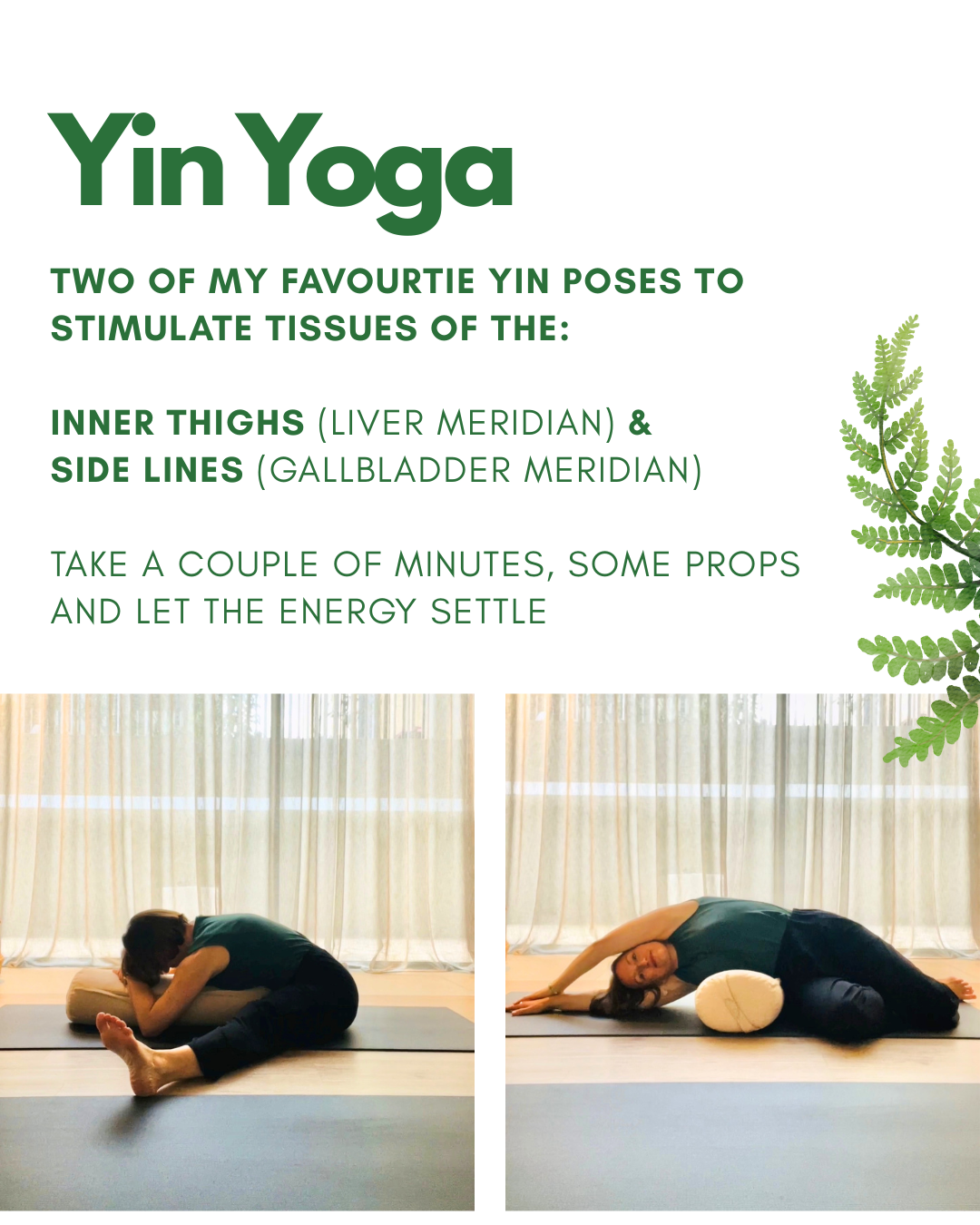
Wood inspired Reflections in Yin Yoga
As you settle into a Yin posture, notice where you naturally want to push because you have a certain expectation or you think the pose should look a certain way.
This is another opportunity to explore Wood:
What happens if I soften the effort?
Can I soften the grip on how the pose should be? ...Where is this ‘should’ coming from?
When am I forcing or pushing, and when am I allowing?
Where do I notice resistance?
Can I stay curious rather than judging what I feel?
Sometimes flexibility begins with letting go of an expectation or a certain way of seeing things.
Stay rooted while you grow
There is another quality of Wood that I love: growth doesn't have to mean leaving your roots behind. A tree grows upwards because it is also rooted downwards.
You can explore this physically in your Yin practice by noticing the parts of your body that are supported by the ground. Feel your feet, legs, pelvis or hands connecting with the floor.
Then notice the sensation of lengthening or expanding away from that support.
What helps you feel grounded?
Can you grow and expand without losing your sense of stability?
This can be a useful reflection not only on the mat, but in everyday life. You have plans, a vision to grow - but a mind that takes off leaving the body behind is not helpful for healthy growth. Stay rooted, your body is your home.
When frustration arises
Wood is traditionally associated with anger, and I guess almost no one finds anger a nice emotion. Is is energy in motion that often carries information. Frustration can appear when there is a gap between what we want and what is actually happening.
Perhaps a project isn't moving forward. Someone isn't behaving the way you expected. Something is unfair. Your body isn't cooperating with your plans. Or life has simply taken a direction you didn't anticipate.
You are invited to consider how you respond to the obstacle.
Do we push harder, becoming more loaded with frustration?
Do we become rigid in our approach, feeling tension build in the body?
Do we blame ourselves or someone else, allowing frustration to turn into bitterness?
Or can we pause and find another way forward?
And instead of beating yourself up, find compassion for yourself.
We don't need to judge ourselves for becoming frustrated. We can notice the emotion, acknowledge it and give ourselves enough space to respond differently. The same applies to other people. Sometimes the person who is frustrating us may simply be struggling with their own obstacles. Can flexibility include compassion for ourselves and for others?
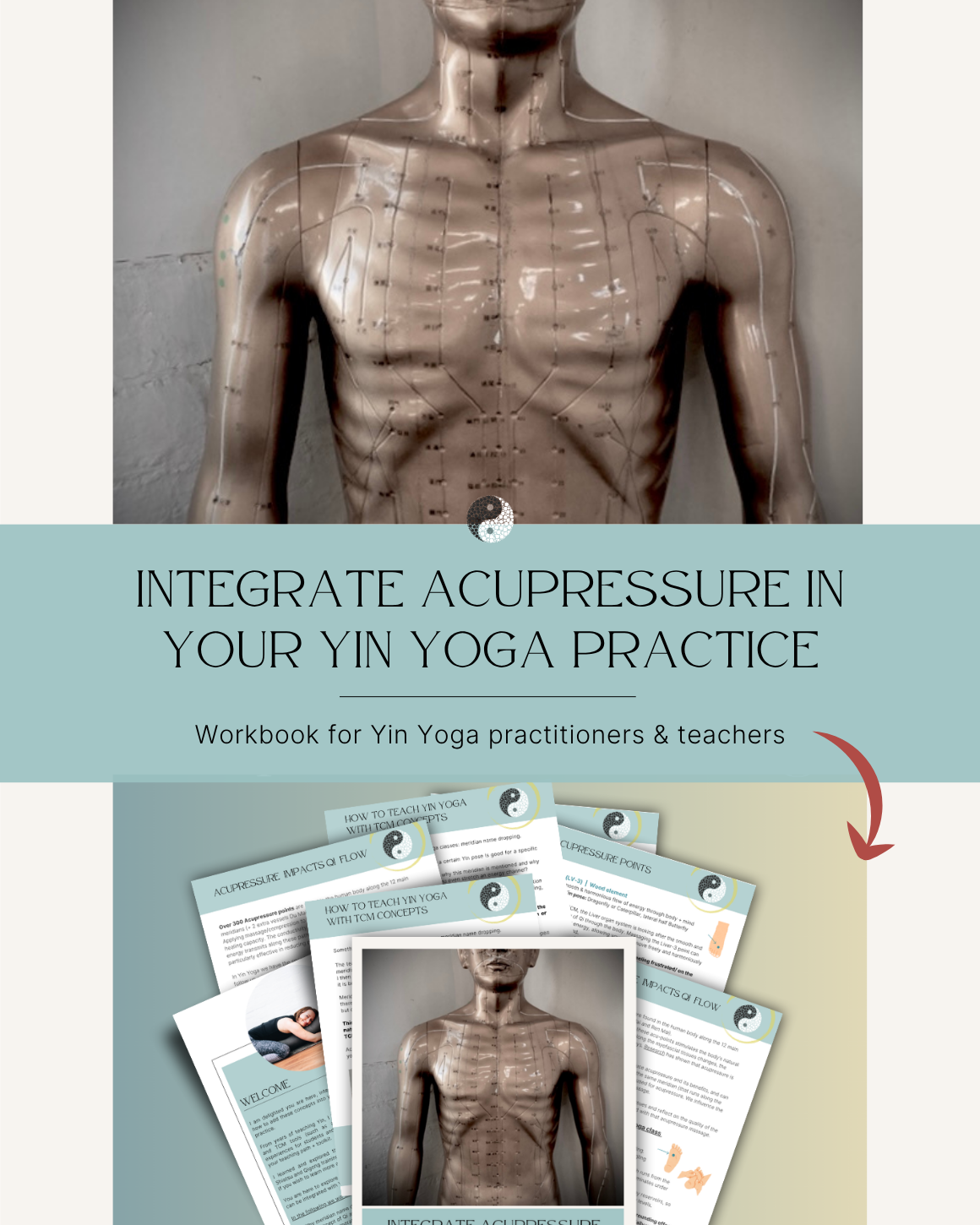
Acupressure and Myofascial release (MFR) for your Wood-inspired Yin Yoga practice:
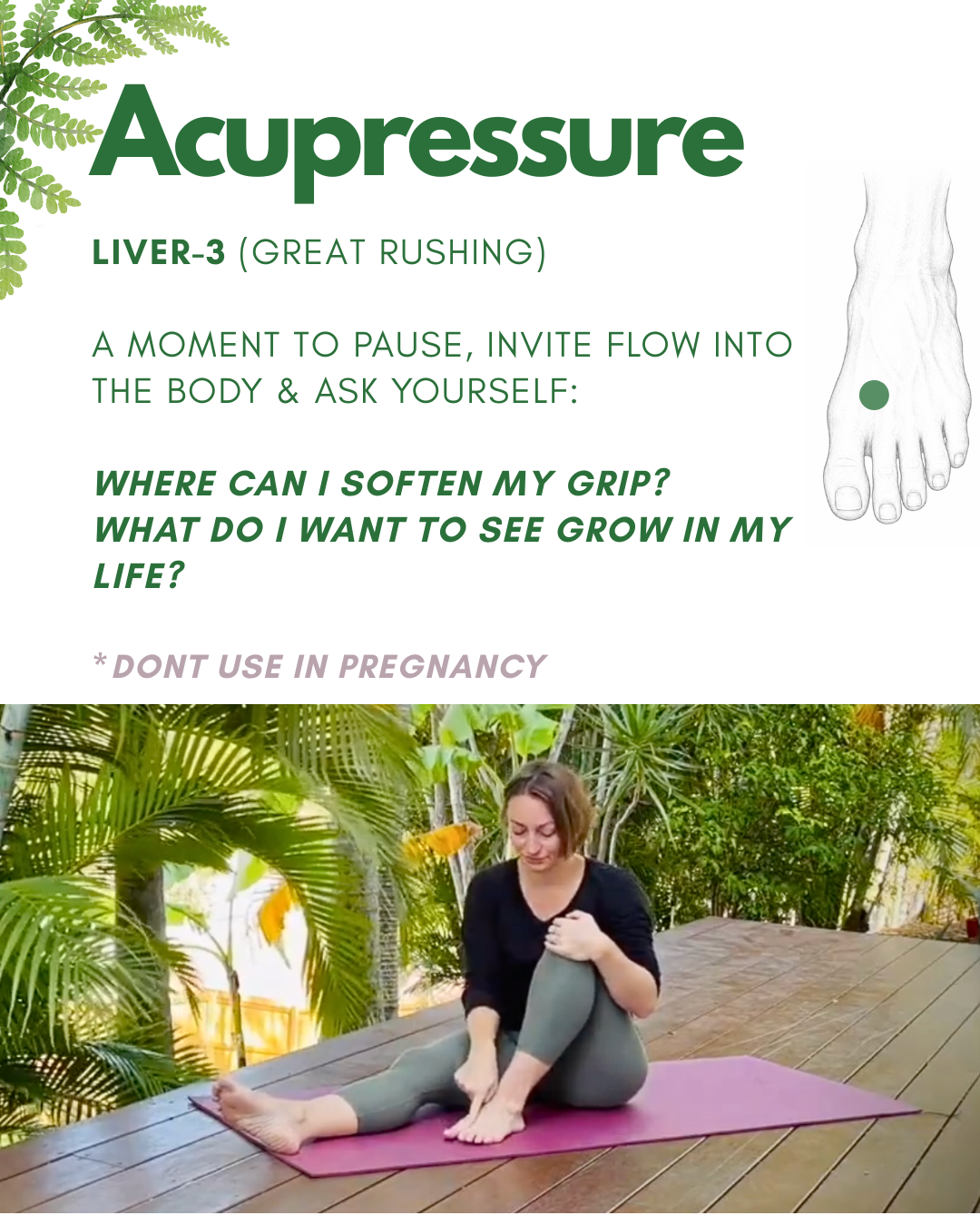
Acupressure: Liver 3 [Great Rushing]
One simple way to explore the Wood element is through Liver 3 (LV-3), also known as Great Rushing, an acupressure point traditionally associated with the Liver channel.
Rather than thinking about acupressure as something you have to “fix”, use this as an opportunity to pause and bring your attention inward.
I love to use this before a Yin Yoga pose and as you feel into the webbing of your tissues, finding the right pressure on this acupoint, ask yourself:
Where can I soften my grip right now?
What do I want to see grow in my life?
These questions bring the Wood qualities of flexibility, direction and growth into your own experience.
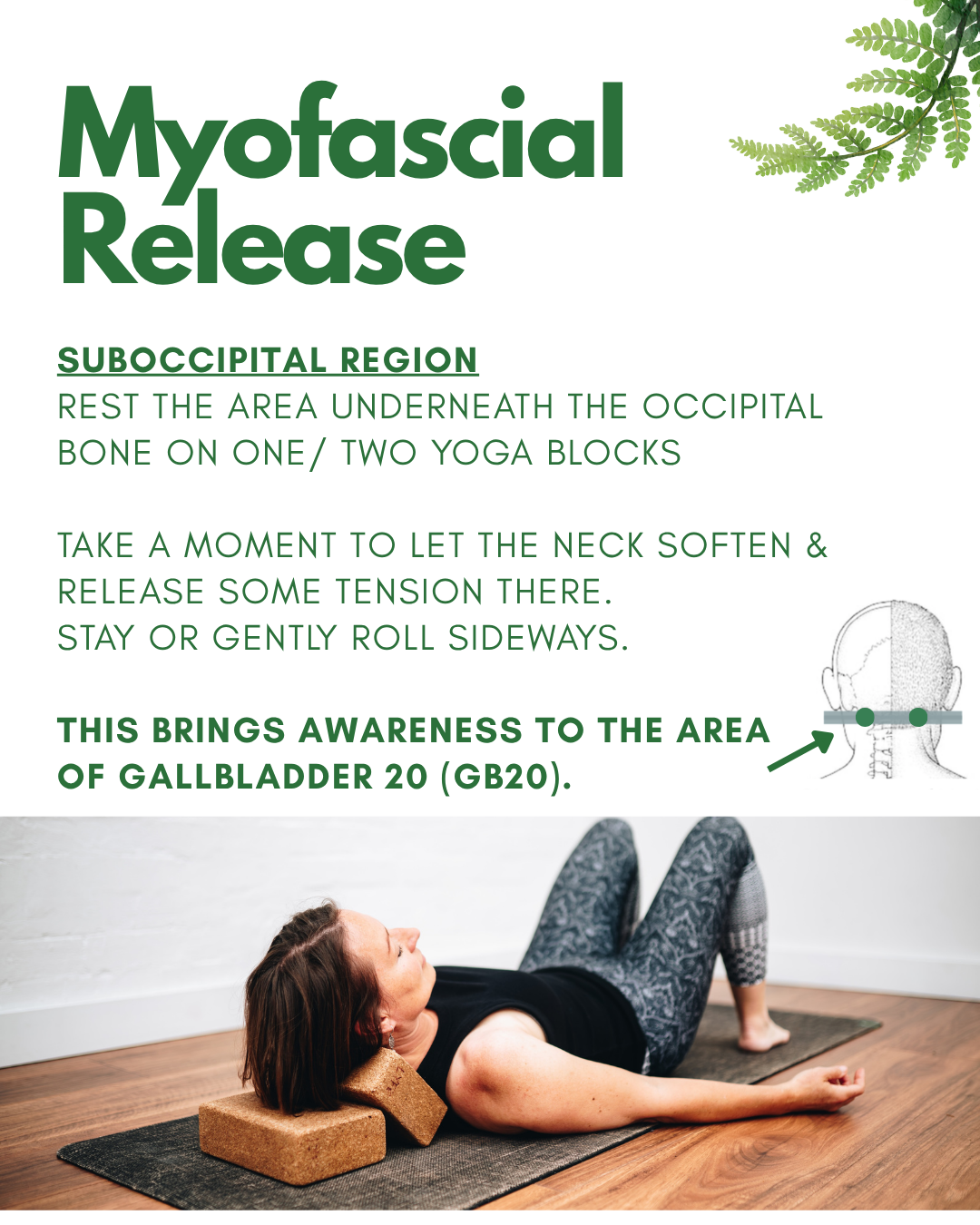
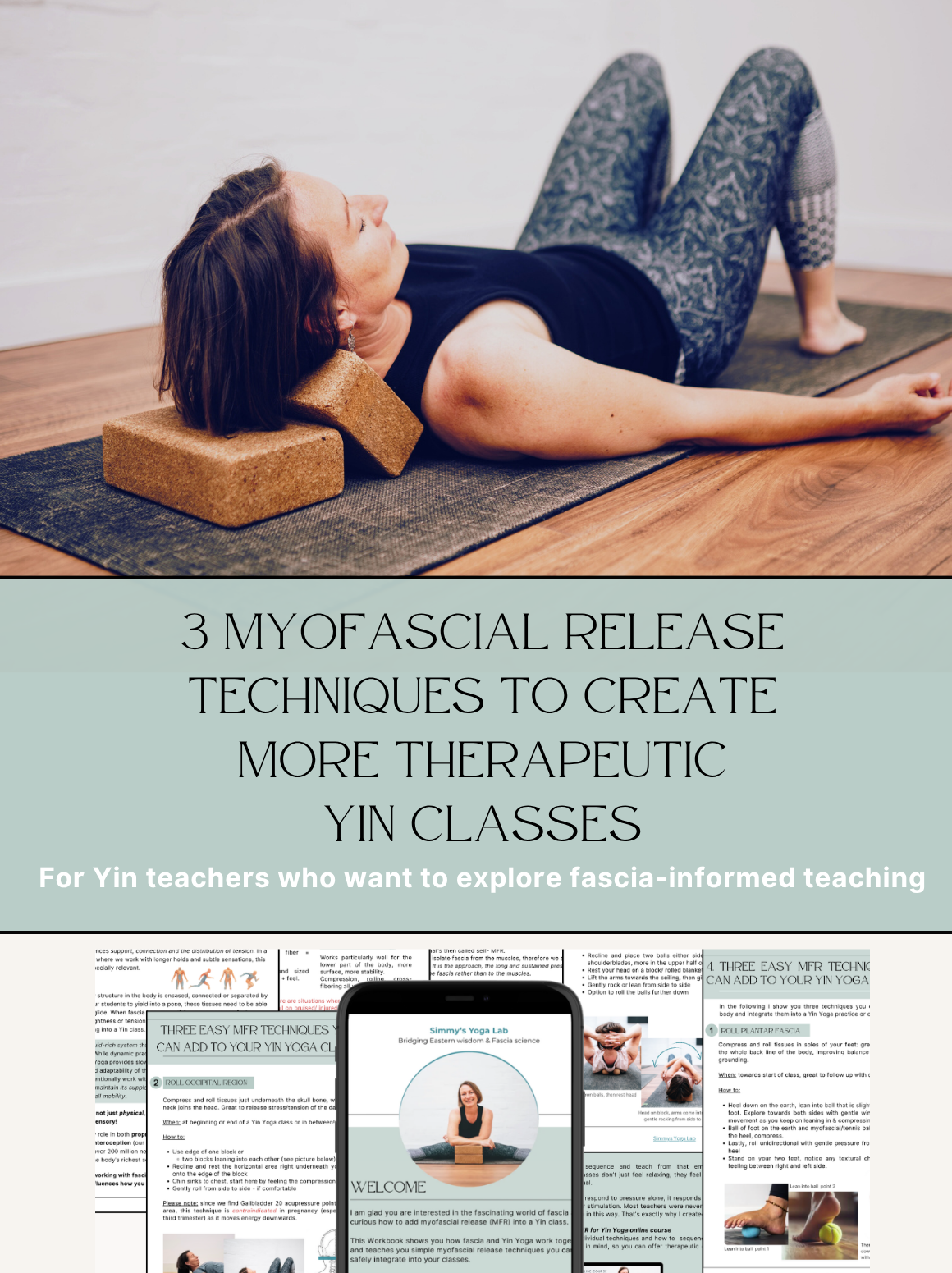
Myofascial release: soften the back of the neck
The area underneath the occipital bone at the base of the skull is often a place where people experience tension from prolonged sitting, screen use or simply holding themselves in a state of effort.
You can rest this area gently on one or two yoga blocks and allow the weight of your head to be supported. Stay still, or slowly roll your head from side to side.
Notice whether you can let the area soften.
This region is also close to the area of Gallbladder-20 (GB-20) acupressure points, another opportunity to bring together the physical experience of myofascial release with the traditional TCM framework.
Let Wood energy inspire you
Spring reminds us that growth doesn't always happen through force. Or through a rush.
A seed doesn't need to become a tree overnight. A tree doesn't grow by constantly pushing harder. It grows through movement, adaptation, nourishment, time and strong roots. So maybe take this with you as you explore the Wood element:
Keep moving, but not necessarily fast or pushing.
Have direction, while remaining adaptable.
Grow, while staying rooted.
When you notice frustration, don’t get consumed by it.
Offer yourself a little more compassion along the way!
Take care and happy spring,
Simone x
And if you like to deepen your Yin Yoga journey to
learn more about TCM concepts or
how to integrate more Fascia focus into into your Yin practice - get my Free Workbooks👇