
Too Much Sitting? Try MFR on GB-30 and Free Up Your Glutes and Hips
Sitting at your desk for too long? Try this simple myofascial release technique for the glutes, followed by Yin Yoga to explore this area in a different way.
We know that sitting for long periods isn't great for our bodies. The hip flexors can become tight from being held in a shortened position, the glutes aren't getting much movement or circulation.
You may even have heard the term “dead butt syndrome” that slightly numb or sleepy feeling you can get when your glutes have been inactive for too long.
For me, sitting at my desk for hours often results in something else: a tingling sensation that travels down my left leg.
Is it sciatica? Is it related to the piriformis? I don't really know and this isn't the place to diagnose it, I leave this to a physiotherapist or doctor to assess.
What I do know is that using my myofascial release balls can bring some ease to the area. One of the places I like to explore is around Gallbladder 30 (GB30), an acupressure point traditionally associated with the hip and leg.
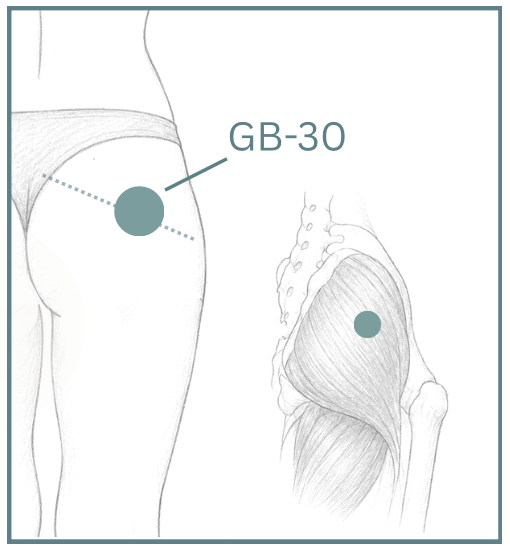
FOCUS on: GB-30
GB-30 is located in the gluteal area, roughly between the greater trochanter (=the bony prominence at the side of your hip) and the sacral area. Anatomically, the point lies over the piriformis muscle and the sciatic nerve.
Don’t become too concerned with finding the exact point, rather explore the deeper gluteal area around GB-30. You are looking for a place that feels relevant to your tension, rather than simply searching for the most painful spot.
Try it with a ball!
Recline with your knees bent and place a tennis ball or therapy ball underneath one side of the glute, around the area for the GB-30 acupressure point.
Pause and breathe. We are not chasing sensation or hunt for a painful spot. Give the tissue some time to respond. Let the knees fall to the side and notice the point of compression.
Then cross the opposite leg over and gently rock or sway (as shown in the video)
I particularly like this technique when tension in the glutes seems to radiate down the leg. It can also be a useful way to explore general hip and buttock tension or discomfort associated with prolonged sitting.
Remember: Less is more here. The sensation should feel therapeutic and manageable, not sharp, electric or overwhelming.
Follow up with Yin Yoga
After releasing the area, I love to move into reclined pigeon, also called number 4 shape, by crossing the outer ankle of one leg over the opposite thigh.
Then wrap the crossed leg further over the supporting leg and allow both knees to fall gently to one side to settle into Twisted Roots.
If the legs feel restricted, loosen the bind or place a block, blanket or bolster underneath the upper knee. Let the arms open out and allow the shoulder blades to settle towards the floor.
The time in your twist gives you an opportunity to notice the area around your buttock running into the leg.
You might notice more space, a different quality of sensation, or simply that the body feels a little easier. Stay for 2–3 minutes, return to centre and explore the other side.
Why I like combining MFR, acupressure and Yin
This is one of the things I love about combining myofascial release, acupressure and Yin Yoga.
The ball gives you a targeted stimulus to explore the myofascial tissues around the gluteal area. Then Yin Yoga gives you time to slow down and sense what has changed. This can be build into a longer Yin Yoga practice with emphasis on the Gallbladder meridian or the Wood element.
If you teach Yin Yoga
Most of your students have probably spent most of their working day sitting, too.
You can incorporate this simple ball release into your next Yin class as a way of bringing some attention to the glutes and hips before moving into the slower, more spacious part of the practice.
A somatic, targeted input before settling into Yin Yoga can make the rest of the practice feel quite different.
Simone x