Working with the Metal element in Yin Yoga for clarity & release
When we practice Yin Yoga, we spend time with the denser, more Yin tissues of the body (the fascia, joints, ligaments) and perhaps more importantly, we spend time observing the subtle landscape of the mind.
The reflective quality and the effect of the physical poses on the Yin tissues align well with concepts of TCM, including the five phases or elements: wood, fire, earth, metal and water.
Among these phases, Metal can sometimes feel the most abstract. Wood feels aspiring and growing. Fire feels alive and expressive. Water feels intuitive and fluid. Earth feels nourishing and grounding. But Metal?
Understanding the Metal Element
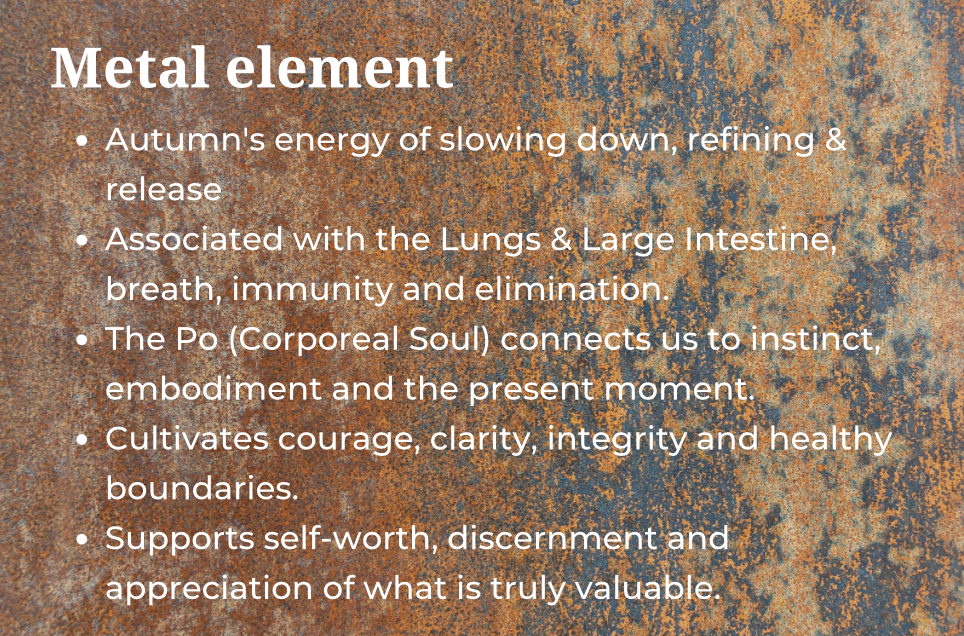
Metal emerges from the abundance of the Earth element, when minerals form through pressure and time. It represents refinement, structure and value. Its energy moving inward and down, discerning and precise. We can feel this too, and when in balance these qualities cultivate:
Clarity and discernment
Healthy boundaries
Self-worth and integrity
Inspiration and deep appreciation for life
The Organs of Metal: Lungs & Large Intestine
Within the body, Metal element is connected to the Lung and Large Intestine and their meridians. The Lungs govern respiration and our relationship with receiving life: breath, inspiration, connection. The Large Intestine governs elimination and release. Together, these paired organs speak to one of the central teachings of Metal: the balance between taking in and letting go.
A healthy Metal phase allows us to discern what is essential and what is not. On various levels (physically, emotionally, mentally, spiritually) Metal asks: What is of value and what are we holding onto that no longer serves us?
The Spirit of the Lungs: The Po
In TCM, each organ system houses a spirit. The Lungs are home to the Po, often translated as the “corporeal soul.”
The Po is deeply connected to the body, the breath and our immediate sensory experience. It governs our animal instinct, physical awareness and our capacity to feel and process emotions (especially grief). This now relates to our psycho-spiritual realm.
When the Po is balanced, we feel:
Grounded in the body
Present and connected to life
Able to experience emotions and release them naturally (not cling to them, or hold on)
When imbalanced, we may experience:
Lingering grief or sadness
Disconnection from the body
Difficulty letting go of past experiences or attachments
The corporeal soul Po anchors us in the present moment and reminds us of the impermanent nature of life.
In a Yin Yoga practice, we might reflect on how often we resist change or cling to what is familiar. The wisdom of Metal invites us to soften this grasping, to honour what has been and to allow space for what is next.
“To hold, you must first open your hand. Let go.” Lao Tzu
The Values of the Metal Element
The qualities of Metal are often described as clarity, discernment, integrity and simplicity. There is a precision to Metal energy: Metal refines rather than restricts.
In a world that often celebrates accumulation and constant stimulation, Metal reminds us of the value of space. The pause to be able to see clearly. The boundaries that help us honour what truly matters to us.
Metal is also connected to our sense of value, not only what we find precious and meaningful in life, but how we value ourselves. When balanced, Metal brings a grounded sense of self-worth that does not depend on constant external validation. It offers clarity around personal boundaries, what we allow into our lives and what we choose to release.
The emotions associated with the metal element is grief. This is not seen as something pathological, but deeply human. It is that grief of knowing about the impermanence of everything but also the process through which we learn to release, to honour what was and ultimately make room for new.
Yin Yoga practice to explore the Metal Element
A Metal-inspired Yin Yoga practice does not need to be complicated.
The intention is not to “fix” the body or perfectly stimulate meridians, but to create conditions for observation.
Themes that can guide a Metal Yin practice include:
Letting go of excess effort and tension
Creating space internally and externally
Cultivating clarity and discernment
Honoring grief or transition
Returning to the breath
Physical aspect: Because the Lung and Large Intestine meridians travel through the chest, shoulders, arms and upper back, poses that gently open these areas are often chosen in a Metal-themed practice. The use of chest opening poses, shoulder stretches, supported backbends, and shapes that encourage spacious breathing can all complement this energetic focus.
Below are a few shapes I often include in my Metal element sequences:
Seated spinal cord breathing (Qigong adaptation) with eagle arms
→ Focus: Gentle opening of front and back through breath awareness, with eagle arms gently tugging on the tissues in upper back, outer shoulder and arms
Melting Heart (Anahatasana)
→ Focus: lungs sinking along with the heart to the earth, release heavinessThread the Needle
→ Focus: notice the tissues around your shoulderblade running into the arm and the gentle spiral of the ribs and lungsOpen wing pose
→ Focus: feel into the connection from your lungs into the inner arm down to the fingers of that side that is resting on the floor. Feel the turn of the lungs as you roll the other side of the body away from the floorSupported Fish / Reclined Heart Opener
→ Focus: gently guide your awareness along the energetic pathways of the lungs
Mental-emotional aspect: The deeper practice may simply be learning how to stay. To stay present long enough to hear the quieter wisdom of the body.
Themes for reflection you could weave into your class:
What am I ready to release?
What truly matters to me at the moment?
Where can I soften my grip a bit?
What do I truly value in myself?
There is something very “Metal” about learning to recognize that our value is not something we must constantly earn.
“When I let go of what I am, I become what I might be.” Lao Tzu
Just as our precious metal is refined through the element of fire, the practice about uncovering what is already essential underneath all the excess.
Acupressure Points to accompany a Metal inspired Yin practice
Integrating acupressure into Yin Yoga can deepen the energetic impact of your classes. This is solely done to gently stimulate the free flow of energy along these pathways and reflect - not to fix anything pathological. We kindly invite energy (Qi) awareness and focus into our body-mind. Any help with specific health issues can be obtained from a licensed acupuncturist.
Some key points to support the Metal element to invite energy flow and awareness into the body-mind:
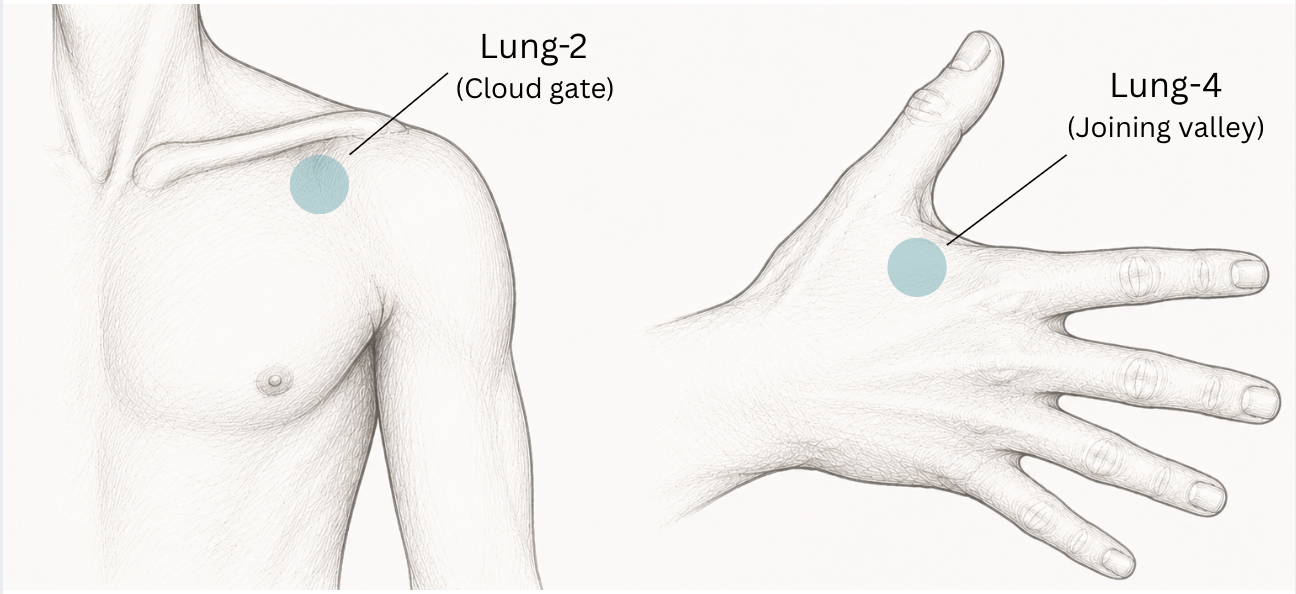
1. Lung 2 (Yún Mén) – Cloud gate
Location: in the hollow directly under the outer edge of your collarbone
Benefits:
Opens chest for better breathing and dispels fullness.
Relieves local shoulder and upper back pain
Clears mental fogginess and feelings of being "under a cloud"
In practice:
you can usefingertip pressure or tapping here and encourage slow, conscious breathing. Another option is to place a myofascial release ball into this area as you lay down on your belly (prone position), or to use the block technique that I am using in the short video sequence.
2. Large Intestine 4 (Hegu) – Joining Valley
Location: Between thumb and index finger
Benefits:
Powerful point for release and clearing stagnation
Supports emotional letting go
Encourages clarity and movement
In practice:
Invite gentle pressure into the webbing between thumb and index finger and notice the texture and whether it feels tender. Allow for long exhalations.. then do the other side.
NOTE: DO NOT do this in pregnancy- this is contraindicated!
In conclusion:
The Metal element reminds us that letting go is not a loss, it is a refinement. A return to what is essential. And it is a pre-requisite to accepting that ultimately we need to let go of it all one day.
As a teacher, you have the opportunity to guide your students not only into physical shapes to affect the myofascial Yin tissues, but into deeper awareness of what they truly value, what they are holding onto and what might be ready to be released.
And perhaps you remind your students (and yourself) that there is beauty in both: holding and releasing.
Best,
Simone