
Do Yin Yoga and Myofascial release have the same effect on fascia?
Fascia is the body’s continuous web of connective tissue, wrapping, supporting and linking everything from muscles to organs. For Yin Yoga teachers, understanding how fascia responds to load, how the myofascial tracks connect and allow for functional movement can bring clarity and more intention to class sequencing.
As one of our most sensory tissues, working into the fascia builds the bridge to the parasympathetic state of our nervous system (1) and links to how energy flows through the body.
Let’s look at two approaches that work with the fascia:
Yin Yoga (with long, passive holds) and Myofascial Release (MFR, with targeted pressure) and why combining them can be so effective.
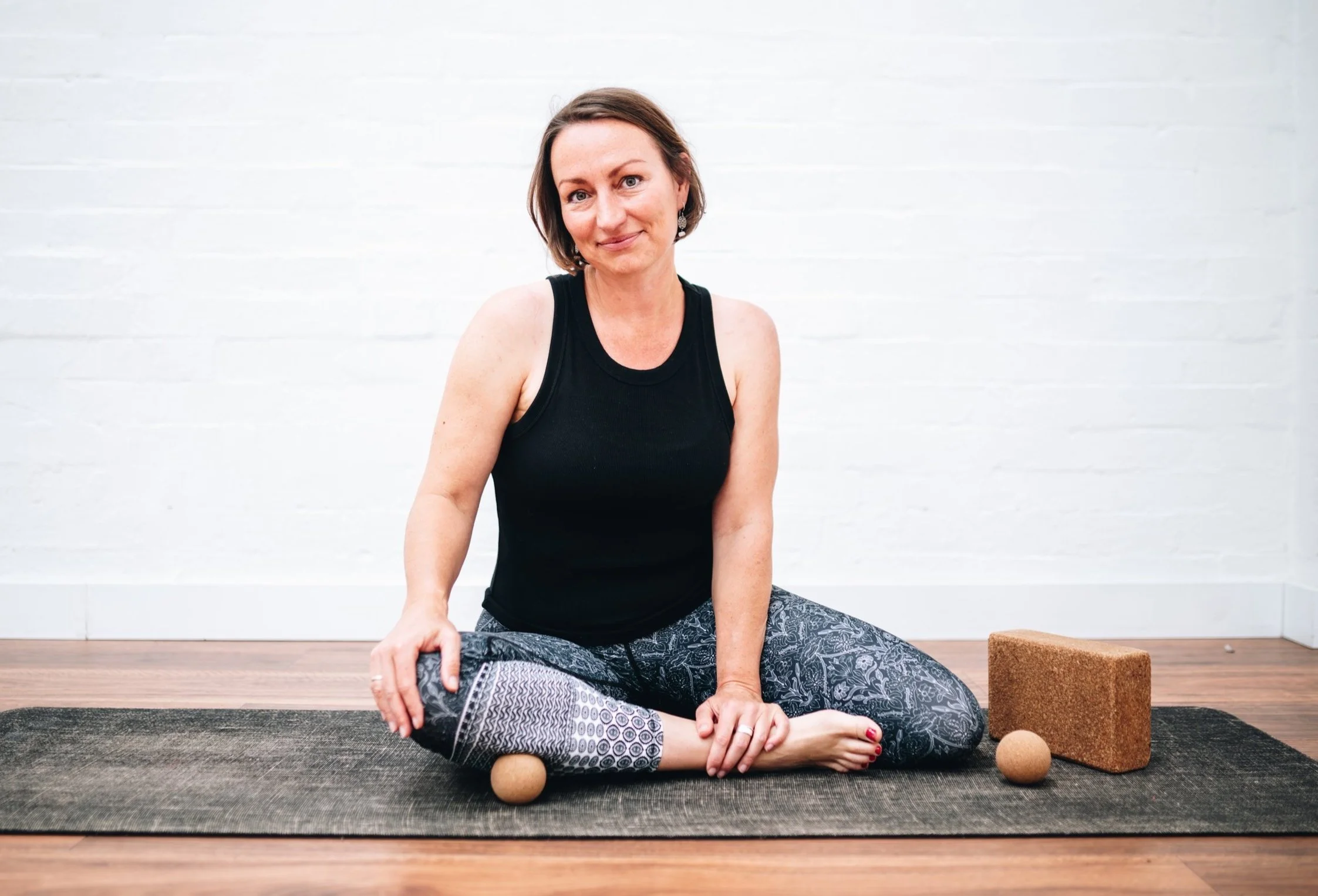
Fascia & Yin Yoga: Time, Stillness and Adaptation
Yin Yoga works with fascia through duration and gentle stress.
When we melt into our Yin poses for several minutes:
Fascia undergoes creep, which is a slow, time-dependent lengthening of this tissue
The tissue begins to rehydrate, which is improving glide between layers and also pressurizes the system
The load in our Yin Yoga poses is broad and global, affecting longer fascial chains rather than isolated parts. This creates a more systemic, integrative effect in the body. Rather than targeting a specific ‘tight spot’, Yin allows fascia to gradually adapt and reorganize over time. This is not great for everyone though, hypermobile people or those that have connective tissue pathologies should be cautious here.
Fascia & Myofascial Release: Pressure and Precision
MFR works with fascia in a more direct and localized way.
Through sustained pressure (with balls, blocks or your hands) you create:
Compression and shear in specific areas
This leads to increased local hydration and fluid exchange and a temporary change in tissue viscosity (making it feel more pliable)
This approach is more targeted and immediate, helping to address densified or less mobile areas within the myofascial network and facilitating hydration.
A slight difference:
Yin Yoga: acts more global, slow, diffuse loading of fascia over time
MFR: acts locally, specific stimulation through pressure
Both influence the viscoelastic properties of fascia, just from different angles. Both go slow and invite inner listening.
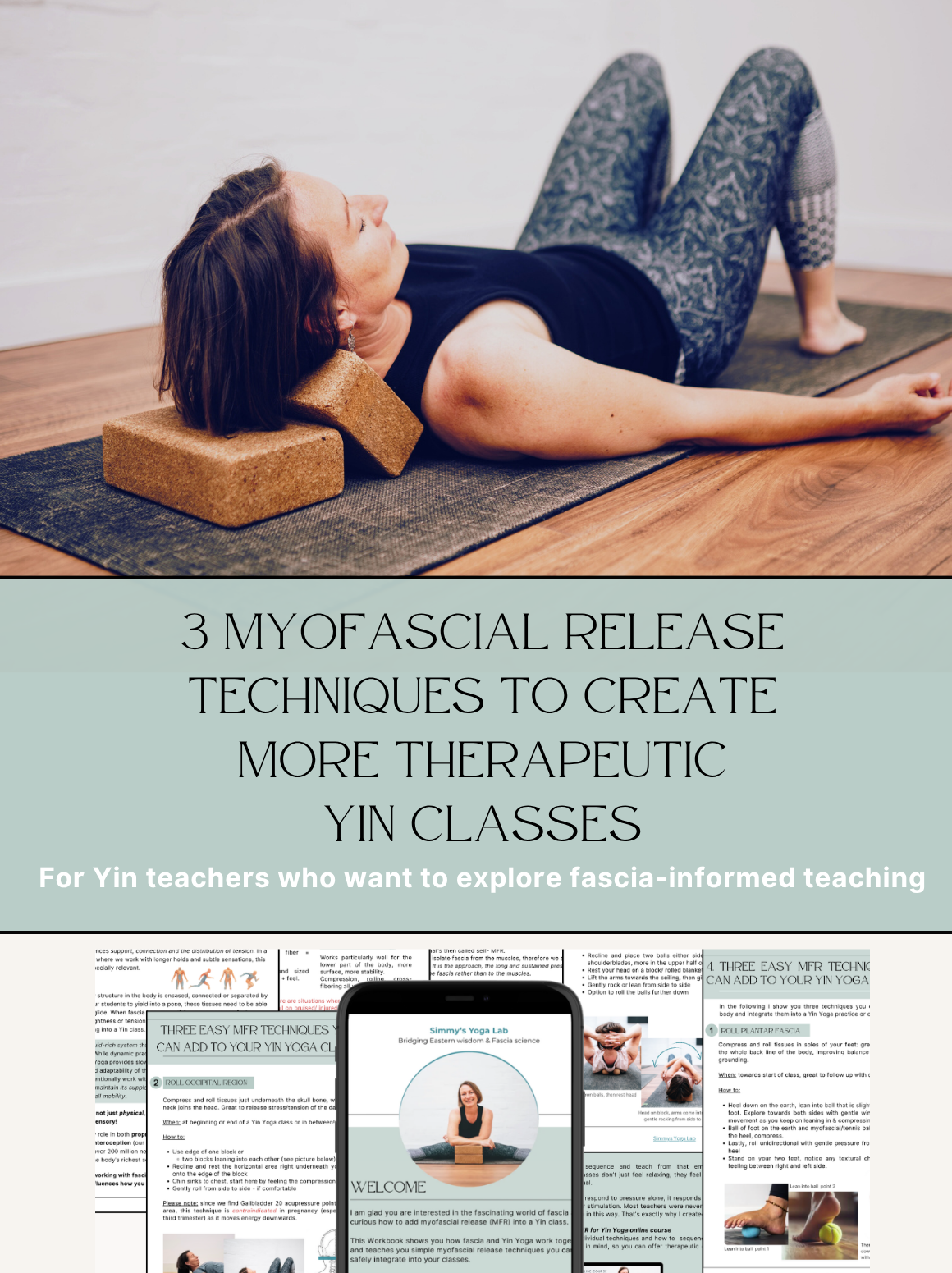
Heard a lot about fascia but don’t know where to start putting this into a class or how to teach this?
Find out how myofascial release is a great tool to intelligently work with your fascia in Yin Yoga.
Start using MFR in your Yin classes
Does Yin Yoga & MFR combination benefit the Fascial System?
When you integrate MFR into a Yin practice, you’re working with fascia in a more complete and layered way:
1. Improved Tissue Hydration
MFR can stimulate fluid exchange locally, making fascia more responsive before longer Yin holds.
2. More Even Load Distribution
By addressing densified areas or areas we usually hold a lot of tension in, the subsequent Yin pose can create a more balanced stretch across fascial chains.
3. Enhanced Adaptation
Fascia responds to both time under tension (Yin) and mechanical stimulation (MFR). Combining them supports more adaptable, leading to increased collagen density and remodeling (1)
4. Let the student land in sensory awareness
Rather than ‘waiting’ for tissue to respond in a long hold/pose, MFR can help the students to arrive in the body, play with sensory awareness and meet long Yin holds afterwards with less resistance.
5. Double invitation to relaxation
The slow pace of Yin Yoga invites us to pause and settle, to become present. Adding MFR brings us into touch with the body, we explore and listen which brings us into the body and slows the overstimulated nervous system.
Simple Practice to Explore
Try this MFR+ Yin combination:
1) ball under the calf (right into the center, both width wise and length wise) let the weight of the leg land on the ball. Option to gently roll forward and back along the length of the muscle fibers as you lift the seat. Explore + listen. Put to the side and feel this compared to the other leg.
2) Tennis ball underneath sole of foot, lean your weight into the ball, then gently roll lengthwise from ball of foot towards heel a few times with gentle pressure only. Put to side and feel left and right foot on the floor, this improves our sense of standing, balance and walking (3)
Then fold forward in eihter dangling pose or caterpillar pose. This first stimulates and hydrates the local fascia, then allows for a more integrated, sustained load through the Yin pose.
Closing Thought:
Fascia responds best to varied, intelligent input.
Yin Yoga offers time and space. Myofascial Release offers precision and stimulation.
Together, they support a myofascial system that is not only more mobile but more responsive and adaptable.
Do we need to let our students know all these effects and how fascia responds to loading? No, that might be too much information.It is up to us to sequence this in an intelligent way, so they can feel and sense that in their own bodies.
Are you using MFR in your Yin Yoga classes?
Let me know!
Best, Simone x
References used:
1) Slater AM, Barclay SJ, Granfar RMS, Pratt RL. Fascia as a regulatory system in health and disease. Front Neurol. 2024 Aug 7;15:1458385. doi: 10.3389/fneur.2024.1458385.
2) Colonna S, Casacci F. Myofascial System and Physical Exercise: A Narrative Review on Stiffening (Part II). Cureus. 2024 Dec 24;16(12):e76295. doi: 10.7759/cureus.76295.
3) Bac A, Kaczor S, Pasiut S, Ścisłowska-Czarnecka A, Jankowicz-Szymańska A, Filar-Mierzwa K. The influence of myofascial release on pain and selected indicators of flat foot in adults: a controlled randomized trial. Sci Rep. 2022 Jan 26;12(1):1414. doi: 10.1038/s41598-022-05401-w.