What Makes the “Yin” in Yin Yoga?
A deep dive for new teachers and practitioners into the Yin aspect of Yin Yoga
When first time students enquire about Yin Yoga, they might read a description like: Yin Yoga is about slow, long Yoga stretches allowing meditative experiences.
Okay, but why is that called Yin then? The founder of Yin Yoga, Paul Grilley named this functional style of Yoga ‘Yin’ for several reasons:
The past decades, the physical part of Yoga were mostly engaging muscles, often trying to achieve a certain peak pose. Paul Grilley learned to immerse in long held Yoga poses from a martial art teacher Paulie Zink and felt the benefits of a slower, more meditative practice. He then developed the practice, integrating anatomical science, adapting to skeletal variations, using five archetypal poses as a foundation for building sequences. He also integrated traditional Chinese medicine and named it Yin Yoga as this slower practice is targeting the body’s deeper connective tissues, not just the muscles.
What aspects make Yin Yoga Yin?
Let’s look at the influences from Oriental medicine that give Yin Yoga that name.
1. Yin and Yang: an interconnected relationship
The Yin and Yang theory comes from Traditional Chines medicine (TCM) or Daoist philosophy, and describes a dynamic interplay of opposing qualities found everywhere within us and around us:
Yang: movement, heat, activity, transformation, the heavens, upward/outward expression
Yin: stillness, coolness, nourishment, grounding, the earth, downward/inward settling
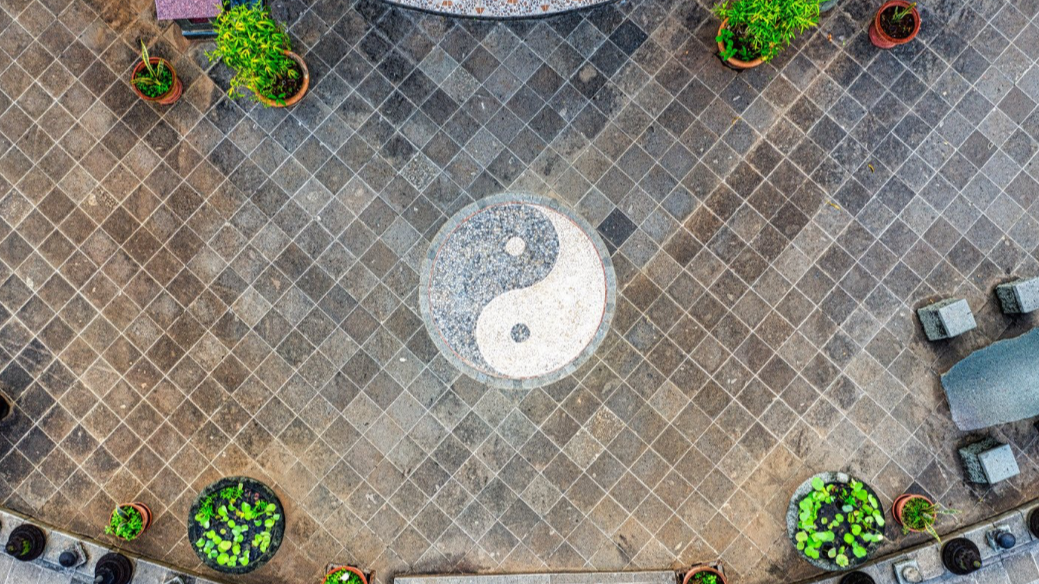
You cannot have one without the other. Neither can exist in isolation. When you think about the Yin Yang symbol, there is always some Yin in the Yang and vice versa. It symbolizes the balance and harmony found through the interaction of opposites.
Rather than thinking of Yin Yoga as slow and passive stretching, forcing us into a still moment, we can view it as a practice that intentionally emphasizes Yin qualities within a Yin Yang continuum. We choose to access Yin, not because it is better, but because it is often what we lack in our overstimulated, Yang-centered world.
2. Yin Is Rooted in the Earth
Yin Yoga primarily happens on the floor or close to the earth. The earth is considered Yin, whilst the heavens are considered Yang in Daoist philosophy.
Earth = Yin. The closer we are to the ground, the more we access the qualities of stability, support, heaviness and yielding.
Heaven = Yang. Standing and moving or balancing poses use effort & muscular activity. This builds a different energy and alertness in the system.
When students sink into their shapes the intention is to orient downward, let gravity draw you down. The focus is to become receptive and not having to hold on so much anymore.
In Yin Yoga poses, the earth is holding us rather than we have to hold ourselves (engaging muscles). The extra support we get through props such as blocks or bolsters also help with that letting go of effort (=muscular engagement).
3. Yin Yoga Targets Yin Tissues: Fascia, Ligaments, Joints
Anatomically, Yin Yoga focuses on the denser, less elastic tissues of the body, what Oriental medicine call the Yin structures: connective tissues such as fascia, ligaments, tendons, joints, bones.
These tissues respond to gentle, sustained stress, time and stillness rather than to quick, repetitive muscular movements (=Yang).
Muscles are considered more Yang, as they are elastic, warm, responsive and drive contraction and movement, they help with the strive and need to get somewhere.
Connective tissues are considered more Yin as they are slower to change, denser and supportive, they hold our being together.
To focus on the deeper Yin tissues, we need to soften and release muscular effort (=Yang). Instead of overriding your natural ‘edge’, that point where you notice a sensation once you enter a pose, we stay there. Less intensity, only use 60-70% of what is your usual capacity and linger there (first and second principle of Yin Yoga). These denser tissues need a bit longer to respond, equally long to recoil/ rebound.
4. Yin Yoga allows for stillness and slowing down
Yin Yoga is often said to be great for beginners - well, I don’t know if that is the case...
The third principle of Yin Yoga is becoming still. Yin stillness is active awareness supported by a passive shape. And this exactly is the challenge: to be in these moments of stillness, witnessing, listening inwards and allowing yourself to simply be.
Who can easily be without doing this these days? We are constantly distracted, doing various tasks at the same time and have access to anything within a click. But a few minutes without distraction, just with ourselves – can be a lot for us.
But it is these moments of stillness that can encourage an inner shift: from doing to being. With the focus on internal sensations, away from outer performance we restore, fill our batteries and this is sensed by your nervous system. You switch to the rest & digest state, which again is considered more Yin.
The stillness component of Yin Yoga:
conserves energy instead of expending it, this feeds our Yin energy
allows inward attention + curiosity, rather than outward focus
a way to switch to the rest & digest state (parasympathetic) of your nervous system
5. Yin Yoga works on the energetic body
More Yang focused practices like Vinyasa, Ashtanga or strength-based training build heat, power and momentum. They use determination and move Qi outward and upward.
Yin Yoga takes a different approach. Most of the Yin Yoga poses stimulate the myofascial areas of the body along which we find the energetic pathways, the meridian system. We can’t be as specific in a Yin practice addressing these lines like an acupuncture needle treatment would, so we speak about sinew channels here. Sinew channels form a network of connective tissue + muscles, similar to the myofascial system, that govern biomechanical functions. Each of these channels follows the general path of a meridian.
In the Oriental medicine system, Yin Yoga poses:
can compresses and/or stretch parts of the sinew channels in slow, sustained ways
upon release, Qi can re-distribute and/or Qi flow is re-established
Quite a few of these energetic pathways are located within the connective tissues, the Yin tissues we work with in Yin Yoga.
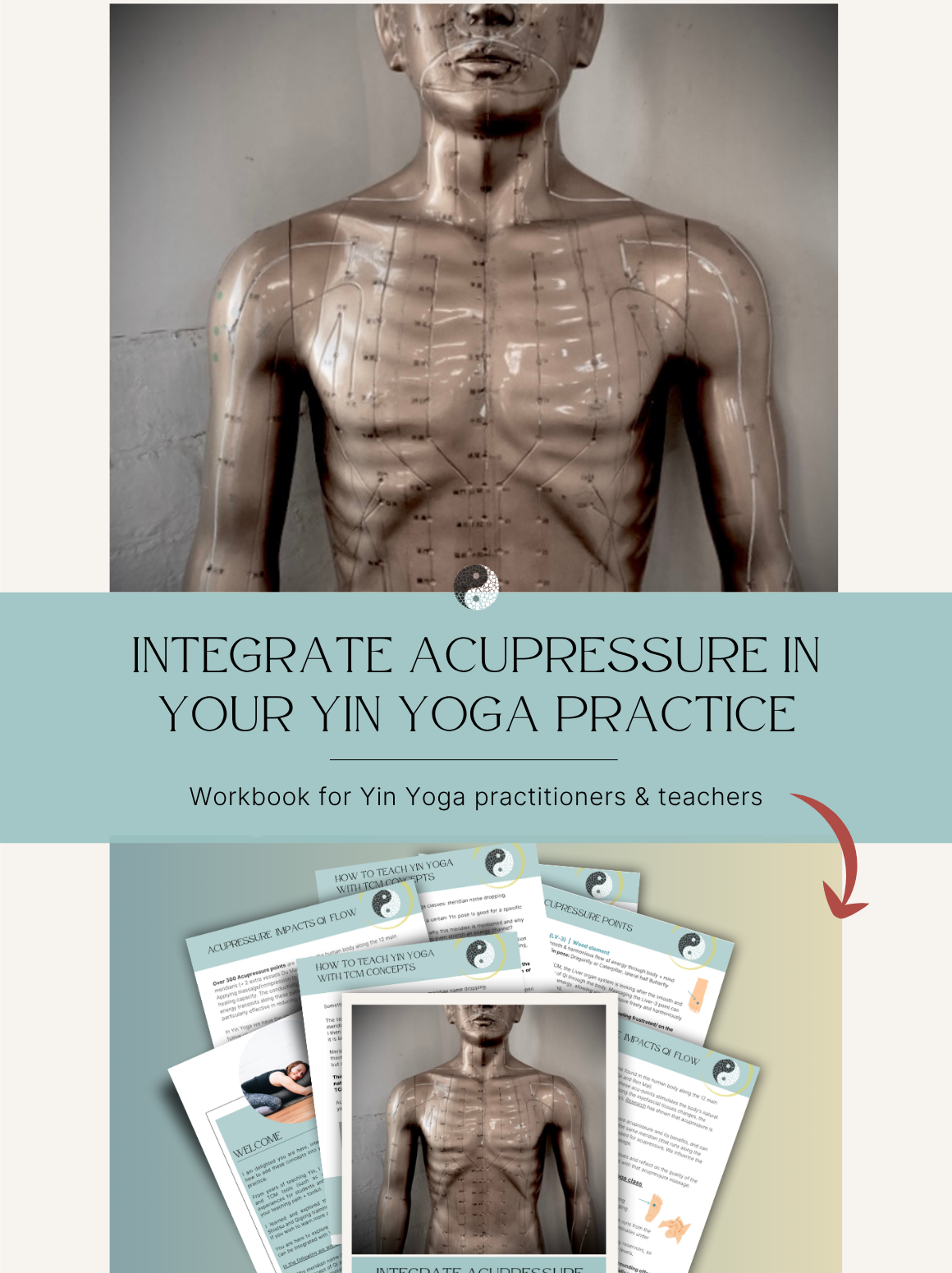
Need some inspiration from the wisdom of Traditional Chinese medicine for your Yin practice?
Dive into Qi cultivation and learn 3 acupressure points to integrate in your Yin Yoga class + practice video.
These were my thoughts on what makes the YIN in Yin Yoga. Of those aspects, I love to focus on the denser tissues (joints and fascia in particular) as well as the energy body in my classes.
If you have any feedback or further ideas you would like to share let me know!
With Yinspiration,
Simone x